The £18 Pistachio: Confessions From Britain’s Doughnut Resale Racket
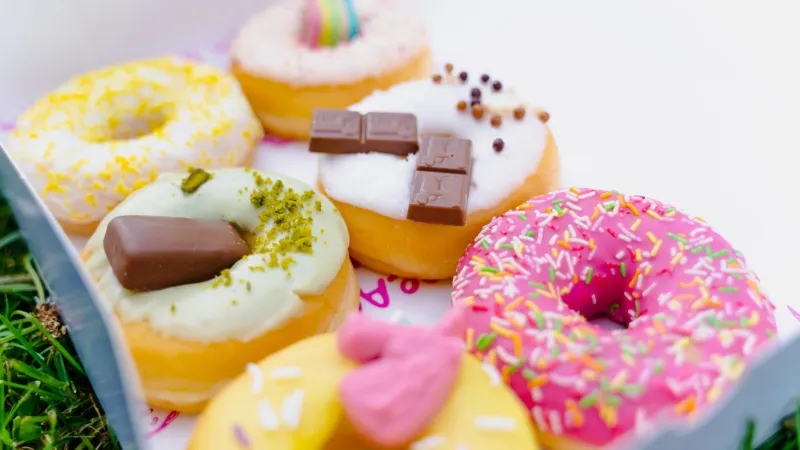
There is a particular look a baker gives you at 9:15 on a Saturday morning. It is not cruelty. It is not even pleasure. It is the flat, weary expression of someone who has already watched twelve people ask whether the pistachio-and-sour-cherry doughnut is coming back, and who knows that the answer will make somebody cry into their flat white. The board says SOLD OUT. The board has said SOLD OUT since 9:14. The doughnuts existed for roughly the length of a podcast intro.
And yet, by 9:40, they are back. Not in the shop. On Facebook Marketplace. Same doughnut. Same box. Slightly tragic description: “Unopened. Slight crease on lid. £18. Collection only. No timewasters.”
Welcome to Britain’s doughnut resale racket: a grey market built on scarcity, impatience and the deeply British belief that if something is sold out, it must be worth queuing for—or, failing that, worth paying a stranger in a car park to have queued for you.
9:14am: The Scene of the Crime
I spent Friday morning at a bakery in Manchester’s Northern Quarter that shall remain nameless, partly because I do not want its staff to suffer another wave of messages, and partly because I want to be able to go back. Let’s call it Crumb & Punishment. It had a chalkboard, a queue that curled past a barber’s and a limited drop of pistachio-and-sour-cherry doughnuts at £4.50 each, maximum two per person.
The rules were clear. The queue respected them. The British queue always does, outwardly. But there is a difference between obeying a sign and obeying the spirit of the sign. The chap two places ahead of me bought his two, walked around the corner, and I watched him photograph the boxes on a low wall like a property listing. By the time I reached the counter, the tray was empty. By the time I reached the bus stop, his listing was live.
This is not illegal. It is not even especially new. Ticket touts have done it for decades; sneaker bots have done it with more flair. But there is something uniquely bleak about applying the logic of the O2 Academy to a fried ring of dough. At least a concert ticket gets you into a concert. A resold doughnut gets you into a low-level argument with your own blood sugar.
The Tout Economy
The obvious flippers are only half the story. The really interesting trade is happening inside offices. In the past year I have heard of workplace doughnut touts—people who take bulk orders, queue at 7am, and deliver to desks for a £2 markup. One team in Leeds apparently has a shared spreadsheet. A shared spreadsheet. For doughnuts. It has a tab called “Glaze Allocation”. I have seen less organised stag dos.
There is also the quiet WhatsApp economy: someone’s cousin’s girlfriend works near a bakery, a drop is announced, a message goes out, and by lunchtime a Tupperware box is circulating around a WeWork like a very sweet, very expensive office conspiracy.
The flippers will tell you they are providing a service. They are not wrong, exactly. They are selling convenience and certainty: you do not have to queue, you do not have to gamble on a 9:14 sell-out, you just have to pay. But convenience has a way of becoming the point. A £4.50 doughnut becomes an £18 doughnut not because it tastes four times better, but because somebody else wants it and cannot have it. That is not pastry. That is pricing anxiety.
A Pre-Loved Box
Naturally, I bought one. For research. I found a listing for a mixed box of four—two pistachio, one brown butter, one “mystery jam”—at £32. The seller described them as “pre-loved”, which is a phrase I would like to retire immediately. They were not pre-loved. They were pre-eaten by time. The box had a faint whiff of someone else’s car air freshener and a lid that had been opened and closed with the care of a passport officer.
Taste test: the pistachio glaze was still pleasant, though it had developed the slightly sweaty sheen of a pastry that has spent an hour in a warm passenger seat. The dough was about 80% as good as the fresh version and 300% as expensive. The brown butter one was fine. The mystery jam was mostly air and regret, which at least made it thematically consistent with the entire enterprise.
The strangest part was the ceremony of it. I had paid £32 for doughnuts that had cost £18 an hour earlier, and I still felt a small, idiotic thrill when the seller handed them over in a carrier bag. That thrill is the whole market. It is not about hunger. It is about having secured the thing.
The Ethics of the £18 Specimen
Here is where the doughnut black market gets interesting. Bakers create scarcity because scarcity creates queues, and queues create stories. A sold-out board is marketing. A “one per person” sign is theatre. None of that is evil; it is just how small food businesses survive in a city where rent is measured in croissants per square metre.
But resale turns the queue into a ticket. The British queue is a social contract: we wait, we shuffle, we tut, we do not push in. Flipping breaks that contract without technically breaking any law. It says the queue is not a shared experience but an opportunity, and the person at the front is not a fellow human but a supply chain.
I am not calling for doughnut regulation. I am calling for shame. A small, well-dressed shame. If you buy two limited-edition doughnuts and sell one to cover your own, fine—that is economics with a sugar coating. If you buy twelve and list them at £18 before the glaze has set, you are not an entrepreneur. You are a pastry parasite.
Should You Pay?
No. Or almost never. Wait for the next drop. Try the bakery’s ordinary doughnut, which is usually better value and rarely has a Facebook listing. If you must buy resale, meet in public, check the box, and remember that no pistachio glaze is worth a car-park handover at 4pm on a Friday.
The real black market, in the end, is not on Marketplace. It is in all of us: the bit that wants the sold-out thing precisely because it is sold out. The doughnut is just the delivery mechanism. And at £18 a pop, it is delivering a very expensive lesson in wanting.
Glazed & Confused verdict: the queue is better than the tout, the fresh doughnut is better than the pre-loved one, and the only thing that should be resold at a markup is a pun. This one’s free.