The Batch Alarm: Why Britain's Best Doughnuts Are a Timing Scandal
Photo: Kevin Payravi, CC BY-SA 4.0, via Wikimedia Commons
There is a specific noise a doughnut makes when it is truly fresh, and it is not a noise at all. It is a silence. The kind of quiet that happens when you bite through a glazed shell and there is no resistance, no apology, no dry little crumb clearing its throat. Just sugar, air and the faint, indecent warmth of something that was, until very recently, bubbling in oil.
Most of us have never heard that silence. Because most of us buy doughnuts at the wrong time, from the wrong counter, for the wrong reasons — and the shops, God love them, are in no hurry to correct us.
The 3:47pm Problem
Here is the scandal in one sentence: Britain's bakeries know exactly when their best doughnuts exist, and they will not put it on the door.
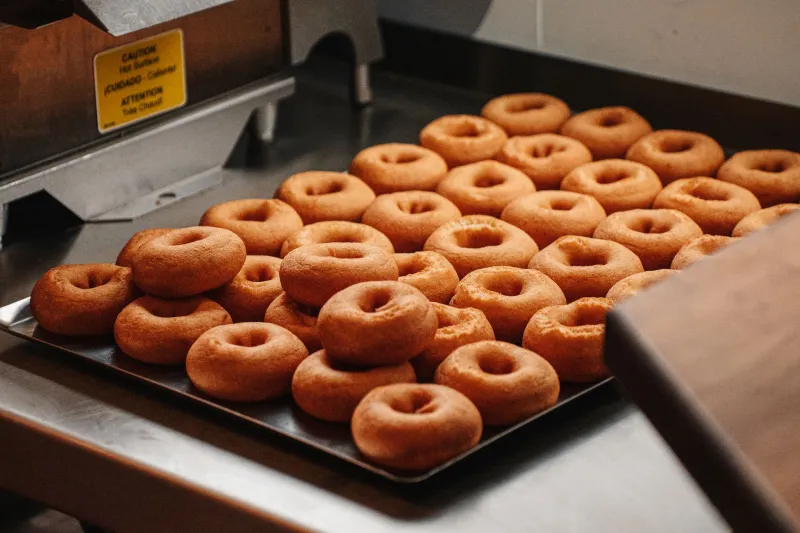
Walk into almost any supermarket bakery counter at 8am and you are buying yesterday's ambition — a decent doughnut, sure, but one that has already begun its slow, dignified descent into chew. Walk in at 4pm on a lucky day and you might catch the second fry of the afternoon, the tray that smells of yeast and hot oil and vague corporate optimism.
That, roughly, is the glaze window. It is not an official term. Nobody at head office will confirm it. But anyone who has worked a bakery shift knows the rhythm: a dawn batch for the breakfast rush, and — in the good shops, the ones that still actually fry rather than defrost — an afternoon top-up aimed at the post-school, post-work, pre-dinner crowd.
Why isn't it advertised? Because a schedule is a promise, and a promise is a lawsuit with icing on it. Fryers break. Deliveries are late. The person who knows how to work the proving cabinet has gone home sick. Shops would rather sell you a vague, atmospheric concept of 'freshly baked' than commit to a time and be held to it by a man with a phone and a grievance.
Spotting a Fresh Batch at Twenty Paces
You do not need to interrogate anyone, though you can. A good field guide should let you assess a doughnut from across the aisle, ideally while pretending to read the ingredients on a loaf of seeded bloomer.
The sheen test. A fresh glaze catches the light like wet paint. If the counter lights reflect off a doughnut in a soft, unbroken smear, you're in business. If it looks dusty and matte, like a sugared doughnut that has given up, keep walking.
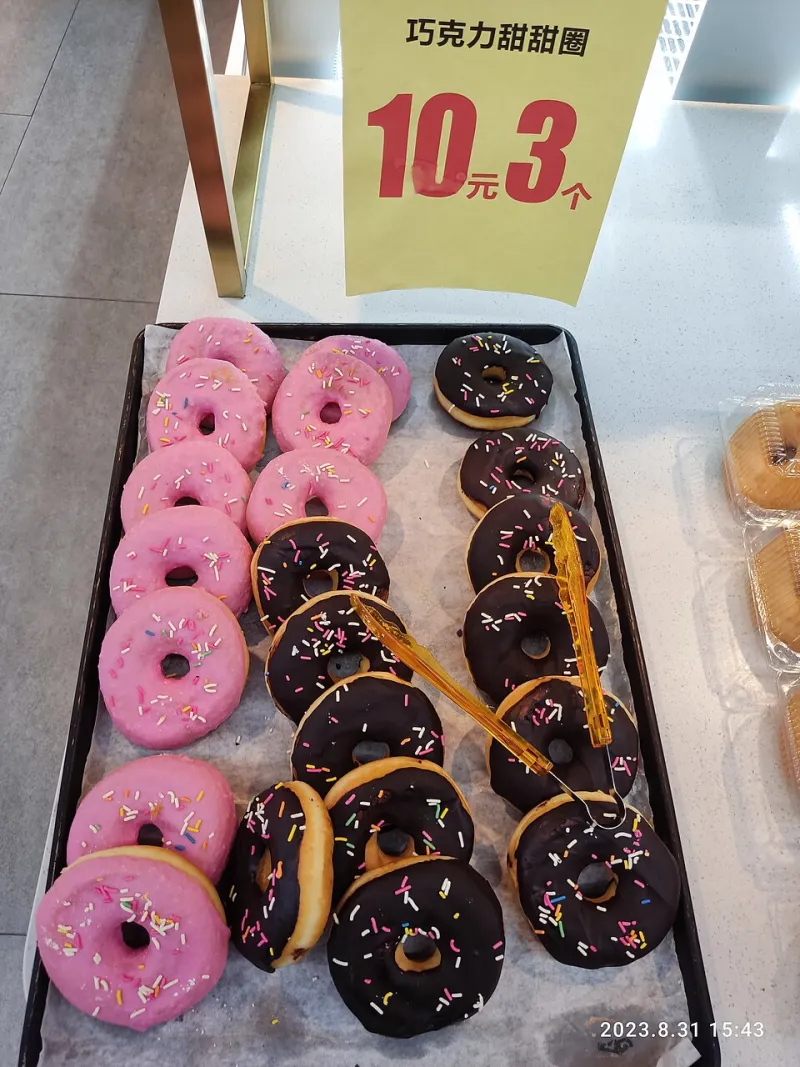
The tray-depth tell. A full, evenly spaced tray means someone has just restocked. A tray with gaps, one sad ring doughnut that has been rotated to the front like a supermarket ready-meal, is the visual equivalent of a shrug.
The steam. Glazed glass, condensation on the inside of the display, a faint haze: warmth. Warmth is your friend. Warmth is also custard's mortal enemy, which we'll get to.
The smell split. Fresh doughnuts smell of yeast and frying — a savoury, almost savoury-bready note under the sugar. Old doughnuts just smell sweet. If the aroma is pure candyfloss and desperation, the batch is a veteran.
The lean. Old doughnuts slump. They develop an angle. A doughnut should sit on a tray like it means it, not like it's resting against a bus shelter.
And yes, you can simply ask: 'When's the next lot coming out?' In my experience, staff answer this honestly about 80% of the time, and gleefully for the other 20% because it's the only interesting thing that's happened all shift.
The Custard Clock
Here is the cruel irony at the heart of the glaze window: some doughnuts peak immediately, and others peak about twenty minutes later and then fall off a cliff.
A ring doughnut, a sugar-twisted thing, a plain glazed — these are best within the hour. They're simple, they degrade slowly, they're forgiving. A filled doughnut is a different animal. Custard wants to be cold, cream wants to be cold, and a doughnut wants to be warm. Put them in the same room and you get a race against time that the custard always loses.
So the real connoisseur's window is narrower than you think. A jam doughnut wants to be fresh but not hot — maybe thirty to forty minutes out of the fryer, when the dough has settled and the jam has had the decency to stop being molten. A custard or cream doughnut should be eaten before it goes in the fridge and after it has cooled — a window of roughly an hour to ninety minutes, after which it is perfectly fine and utterly pointless.
The Instagram Tax
Now for the heresy. The prettiest doughnuts are almost always the worst value.
The one with the unicorn horn, the edible flowers, the drizzle that cost more to design than the flour cost to mill — that is a doughnut built for a phone, not a mouth. It needs to survive transport, a photoshoot, a car journey home and a grid post. That means it is engineered for endurance, which means it is engineered to be slightly stale by design.
The humble £1.20 jam doughnut from a hot tray, eaten standing up on a pavement with your coat sleeve catching the sugar, has never once been photographed for a good reason. It doesn't need to be. It's already perfect.
Building Your Own Glaze Window
You can't make a shop fry at will, but you can stack the odds.
- Go off-peak, but not dead. Mid-afternoon on a weekday beats Saturday 11am, when the queue has eaten the stock and the staff have eaten hope.
- Learn your local. Independent shops in market towns and city edges usually have more consistent fry times than the big chains, because someone there has actual opinions about dough.
- Befriend the 7am crowd. The other genuine window is first thing — if you can get there before 9am, you're catching the first fry, which is the freshest a doughnut will ever be.
- Watch for the 'Hot Now' tradition. A handful of shops still signal a fresh batch with a light or a sign, a lovely bit of theatre borrowed from across the Atlantic. When you see one, abandon your plans.
Set an Alarm, Not a Budget
The uncomfortable truth is that we have spent a decade arguing about price and provenance and whether a doughnut should cost £4.50, while the actual variable — the clock — has gone completely unexamined. A £4 artisan doughnut at 6pm is worse than a £1 supermarket one at 4pm. Every single time.
So treat timing as the ingredient nobody puts on the label. Ask about the batch. Lurk near the bakery counter with the barely-concealed menace of a man checking train times. And when the tray arrives, buy two: one for now, one for the walk home, because the window is short and the custard is watching.